Four color theorem: six map coloring activities
How few colors can you use? Start with a simple map, then try a ring of neighbors. Print six original puzzles and explain why your answer works.
Free worksheets and separate answer keys · A4 and US Letter · No account needed
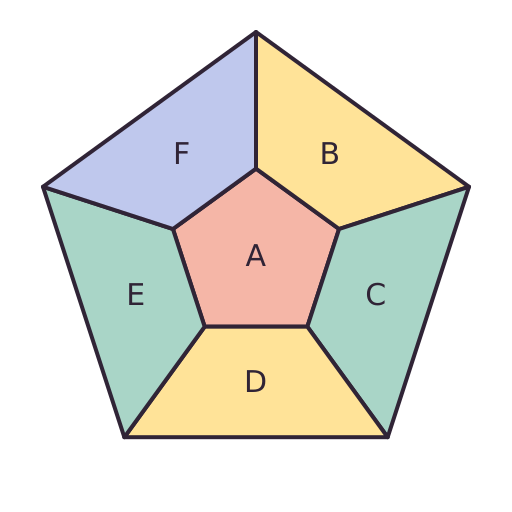
One rule: neighbors need different colors
Two regions are neighbors when they share a stretch of border. Give them different colors. If they touch only at a corner, they may use the same color.
The four color theorem says that four colors are enough for any finite planar map with connected regions under this rule. It does not say every map needs all four. Some of the maps below need only two or three.
For the mathematical statement and proof background, see the proof authors’ explanation at Georgia Tech.
Try the corner test
In puzzle 1, A and D touch at the center point. They can match. A and B meet along a full line, so they cannot match. This makes a two-color checkerboard possible.
For this pack, leave the space outside each diagram white. Only lettered regions are part of the puzzle. Each letter names one connected region; these are abstract maps, not countries.
Finding a valid coloring shows that your number is enough. Explaining why a smaller number fails shows that it is the fewest.
Six map coloring puzzles to try
Use crayons, pencils or four numbered symbols. You can reuse a color in regions that do not share a border. Work out your own answer before opening the solution; changing the color names can give another equally valid answer.
1. Corners do not count
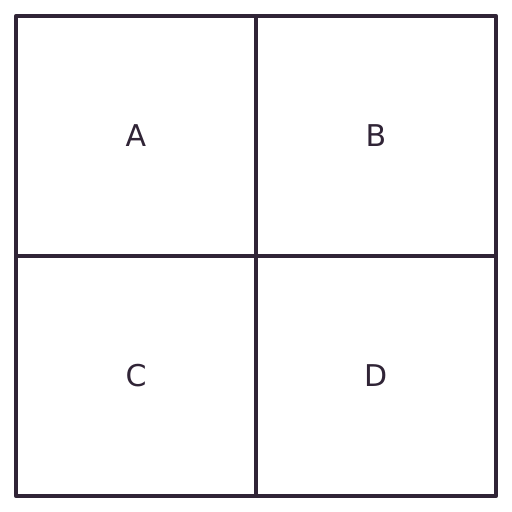
A and D meet at a point, so they may match. A and B share a side, so they must differ.
Show answer for puzzle 1
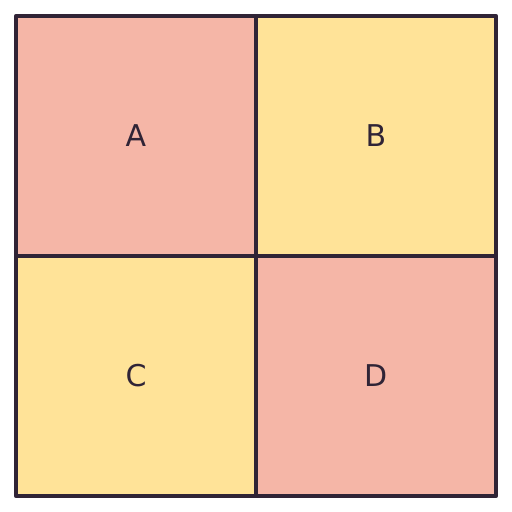
Fewest colors: 2. At least two colors are needed because A shares a border with B. The checkerboard uses two.
Numbered key: A=1, B=2, C=2, D=1. Equal numbers mean the same color.
2. Three neighbors
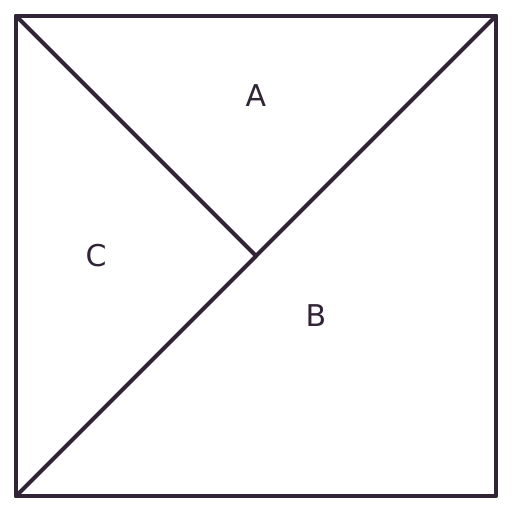
Follow the three lines into the meeting point. Each pair shares a line, not just the point.
Show answer for puzzle 2
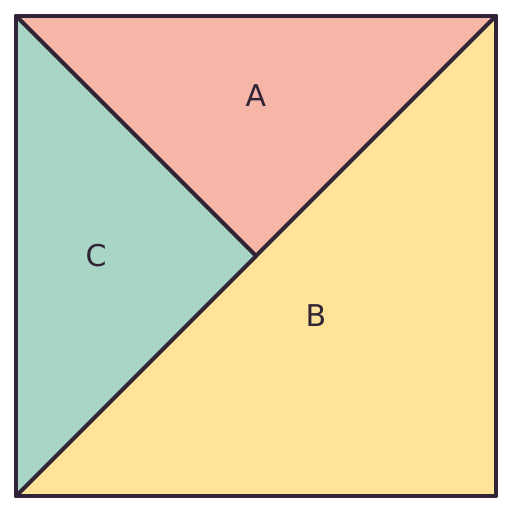
Fewest colors: 3. A, B and C all share borders with each other. That triangle of neighbors needs three colors.
Numbered key: A=1, B=2, C=3. Equal numbers mean the same color.
3. More regions, same two colors
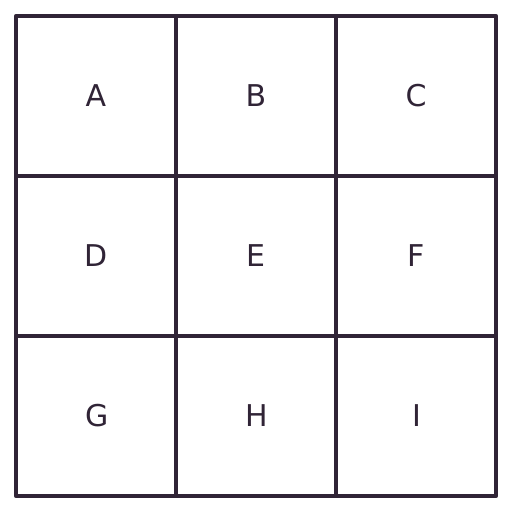
There are nine regions, but only horizontal and vertical neighbors matter. Try an alternating pattern.
Show answer for puzzle 3
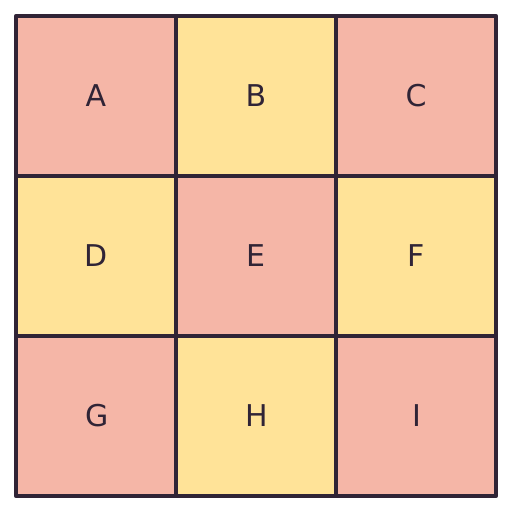
Fewest colors: 2. A and B force at least two colors. Alternating by row and column colors all nine regions with two.
Numbered key: A=1, B=2, C=1, D=2, E=1, F=2, G=1, H=2, I=1. Equal numbers mean the same color.
4. An even ring
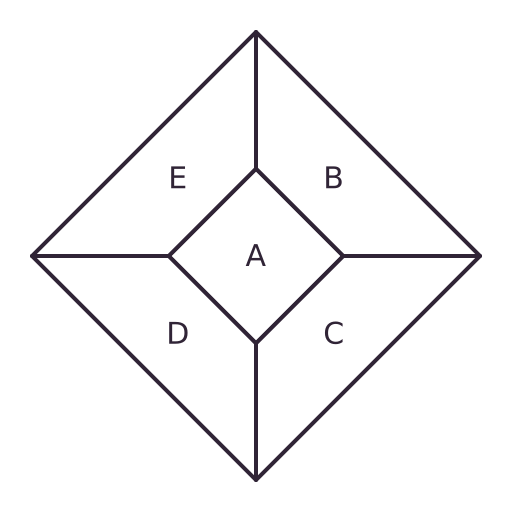
Alternate two colors around the four outside regions. What can you use for the center?
Show answer for puzzle 4
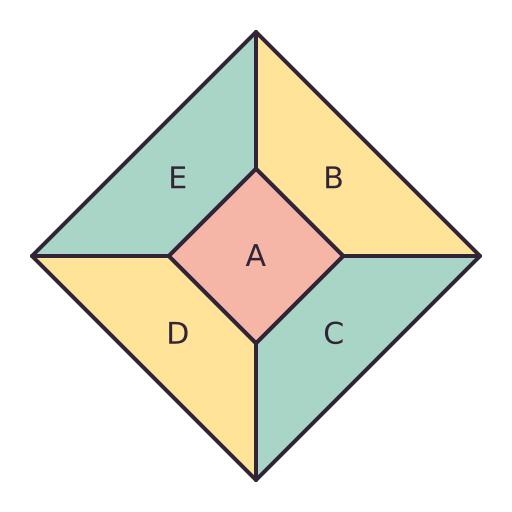
Fewest colors: 3. A, B and C are pairwise neighbors, so two colors cannot work. The even outside cycle uses two colors; A uses a third.
Numbered key: A=1, B=2, C=3, D=2, E=3. Equal numbers mean the same color.
5. Four mutual neighbors
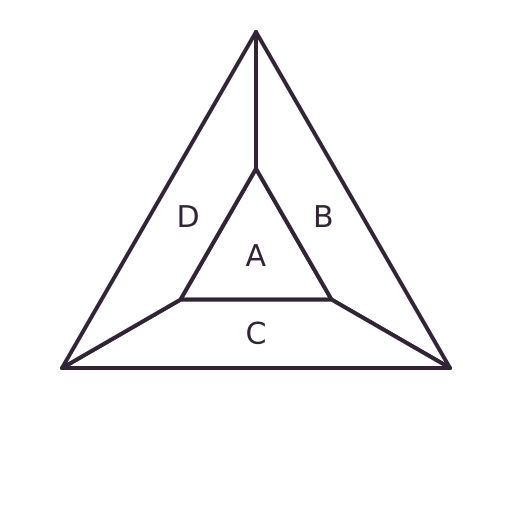
Every region shares a border with every other region. Try to find a pair that can reuse a color.
Show answer for puzzle 5
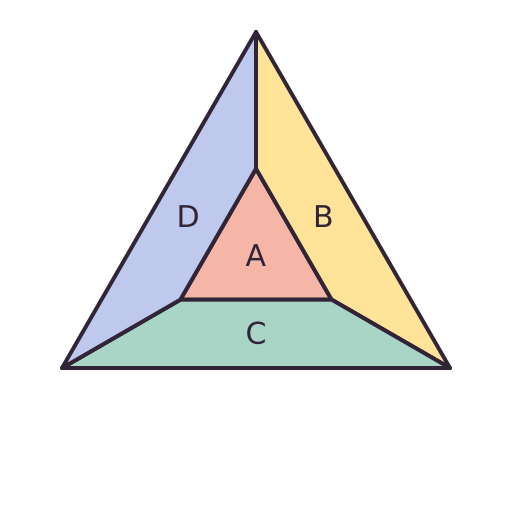
Fewest colors: 4. All six pairs among A, B, C and D share a border. Four mutually adjacent regions require four different colors.
Numbered key: A=1, B=2, C=3, D=4. Equal numbers mean the same color.
6. An odd ring
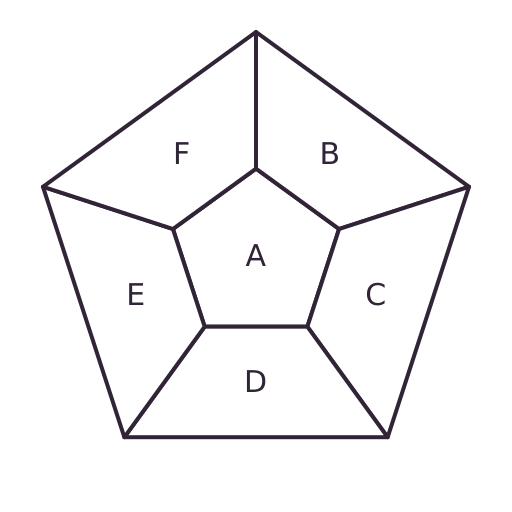
Try alternating two colors around the five outside regions. Watch what happens at the last border.
Show answer for puzzle 6
Fewest colors: 4. The outside five-cycle cannot alternate just two colors, so it needs three. A touches every outside region and needs a fourth.
Numbered key: A=1, B=2, C=3, D=2, E=3, F=4. Equal numbers mean the same color.
Print a worksheet pack or answer key
Each PDF has three pages, with two maps per page. The worksheet leaves space to record a color count and an explanation. The answer key uses both colors and numbers, so it still works in black and white.
| Paper | Puzzles | Answers |
|---|---|---|
| A4 · 210 × 297 mm | ||
| Letter · 8.5 × 11 in |
Choose the file matching your paper and print at actual size or 100%. Keep the answers separate until you are ready to discuss them.
A short activity for a group
- Read the border rule together. In puzzle 1, ask whether A and D are neighbors.
- Work in pairs. One person colors; the other checks every shared border.
- Before revealing an answer, ask: “Which neighbors stop us using one fewer color?”
- Compare the even and odd rings. Explain why the middle region changes the answer.
Use numbered marks instead of colors if that is easier. For a reusable activity, place paper squares marked 1–4 on the regions before coloring.
Why two, three or four colors?
The minimum counts in pack v1.0.0 are 2, 3, 2, 3, 4 and 4, in puzzle order. A computer check tried every assignment with fewer colors and found a valid assignment at each stated minimum. These short arguments explain the same results without a computer.
- 1. Corners do not countMinimum: 2 colors
- At least two colors are needed because A shares a border with B. The checkerboard uses two.
- 2. Three neighborsMinimum: 3 colors
- A, B and C all share borders with each other. That triangle of neighbors needs three colors.
- 3. More regions, same two colorsMinimum: 2 colors
- A and B force at least two colors. Alternating by row and column colors all nine regions with two.
- 4. An even ringMinimum: 3 colors
- A, B and C are pairwise neighbors, so two colors cannot work. The even outside cycle uses two colors; A uses a third.
- 5. Four mutual neighborsMinimum: 4 colors
- All six pairs among A, B, C and D share a border. Four mutually adjacent regions require four different colors.
- 6. An odd ringMinimum: 4 colors
- The outside five-cycle cannot alternate just two colors, so it needs three. A touches every outside region and needs a fourth.
The last puzzle has no group of four mutually adjacent regions. It still needs four colors: its five outside regions form an odd cycle that needs three colors, and the center touches all of them. Counting regions or looking only for four mutual neighbors is not enough to solve every map.
Where the maps and answers come from
ColorPage made these six abstract maps from square grids, a three-region partition and polygon rings. The drawings and their coordinates are original to this pack; the four color theorem is established mathematics.
For each map, we built a graph: one node per lettered region, one edge per shared border. We then tested color assignments using one, two, three and four colors, stopping at the first valid assignment. A separate checker rebuilt the shared-edge list from the coordinates and checked that the polygons cover the diagram without overlapping interiors or gaps.
Scope: these checks establish the answers for six finite examples. They are not a proof of the four color theorem, and we have not measured learning outcomes. The outside is excluded and no disconnected regions share an identity.
Check or adapt the pack
- Coordinates, neighbors and answers (JSON)
- Method and calculation details
- Independent Python checker — download alongside maps.json and run
python3 reproduce.py; Python 3 only, no extra packages. - Source notes, scope and limitations, and file checksums.
Original maps, worksheet files, graph data and checker: CC BY 4.0. Credit “ColorPage map coloring activity pack, v1.0.0” and link to this page. This permission covers this activity pack; public-gallery licenses are separate.
Read the mathematics
- Robertson, Sanders, Seymour and Thomas: The Four Color Theorem — the proof authors’ account of the theorem, adjacency rule and proof approach.
- Leo Rogers, NRICH: The Four Colour Theorem — mathematical context and the connection between map regions and graph vertices.
By ColorPage editorial team · Version 1.0.0 · Updated November 1, 2026. Found a wrong border or answer? Send a correction with the puzzle number.